Vein Finders for Hospital Leadership
Managing costs while maintaining high standards of patient care is a constant priority for hospital executives. Difficult IV access is one of the most common yet often overlooked challenges to meeting this goal. Over 300 million peripheral IVs are placed annually in the U.S., yet first-attempt success rates for staff nurses are only 44%–77%. Every failed attempt wastes $28–$35 in supplies and labor, triggers delays of 30–60 minutes when escalation is required, and puts patient satisfaction scores, and the Medicare reimbursements tied to them, at risk.
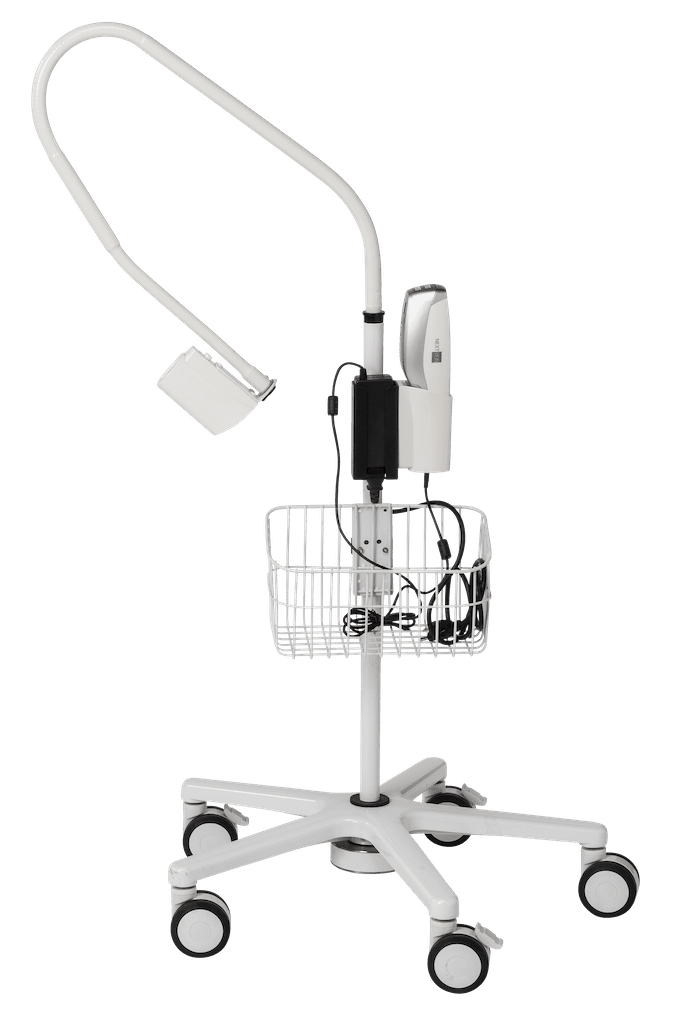
Vein visualization technology gives clinical staff a real-time map of the patient’s veins projected directly onto the skin, supporting more accurate vein access and reducing the resources spent on multiple attempts. For hospital leadership evaluating ways to improve both efficiency and patient experience, vein finders represent an attractive investment with direct operational impact.
The Operational Case for Vein Visualization
The costs of difficult venous access extend well beyond the IV attempt itself. When peripheral access fails, the escalation cascade is expensive: $300–$1,000 or more per unnecessary PICC line placed due to difficult venous access, and $48,108 per CLABSI infection — a CMS “never event” that hospitals absorb in full with no reimbursement.
Clinical studies show that vein visualization technology reduces average IV insertion attempts from 2.3 sticks to just 1.18 sticks, a 49% reduction. For a 100-bed hospital, that translates to an estimated $582,128 in annual savings across reduced stick attempts, nursing efficiency, PICC line avoidance, and CLABSI prevention — with a break-even period of approximately 1.5 months.
Benefits
- Vein imaging can reduce the supplies and staff time associated with multiple IV attempts
- May positively influenceH CAHPS scores related to IV access and procedure comfort, supportingMedicare earn-back reimbursements
- Fosters clinical staff confidence across departments
- Can reduce escalations to second-level experts when first-level access is unsuccessful
- May reduce unnecessary PICC line placements driven by difficult peripheral access
- Lightweight, handheld device that requires no installation or dedicated space
- Can be shared between departments and clinical settings
Why NextVein?
The NextVein V800NV delivers near-infrared vein imaging at a price point significantly lower than leading alternatives, making hospital-wide or multi-department deployment practical without a major capital investment.
Every system is covered by the NextVein Total Protection Plan, which includes a no-questions-asked warranty and an equipment forward-swap program — so your facility investment is protected.
References
- Alexandrou, E., Ray-Barruel, G., Carr, P. J., Frost, S., Inwood, S., Higgins, N., Lin, F., Alberto, L., Mermel, L., & Rickard, C. M. (2015). International prevalence of the use of peripheral intravenous catheters. Journal of hospital medicine, 10(8), 530–533. https://doi.org/10.1002/jhm.2389 | Accessed 26 Dec 2020
- Whalen, Madeleine MSN/MPH, RN, CEN; Maliszewski, Barbara MS, RN; Baptiste, Diana-Lyn DNP, RN Establishing a Dedicated Difficult Vascular Access Team in the Emergency Department, Journal of Infusion Nursing: May/June 2017 – Volume 40 – Issue 3 – p 149-154 | Accessed 26 Dec 2020