A Buyer’s Guide to Choosing the Right Vein Finder
You’ve decided your facility needs a vein finder. The hard part is choosing among the options. Marketing materials from different manufacturers sound nearly identical, and spec sheets focus on numbers that don’t always translate into clinical performance. This guide walks you through what actually matters in the evaluation, in the order most buyers face the decisions.
If you’re earlier in your research and want background on how vein visualization technology works, start with our Complete Guide to Vein Finder Technology. This guide assumes you’ve moved past that stage.
Start by clarifying what you’re actually solving for
Before evaluating any device, get specific about your facility’s needs. The best vein finder for a busy emergency department may not be the best device for a med spa, and a 200-bed hospital doing an enterprise rollout evaluates differently than a small infusion center buying one or two units.A few questions to answer before you talk to any vendor:
- What’s your primary use case? Inpatient IV access, outpatient infusion, blood draw, pediatric care, cosmetic injection planning, and surgical mapping all have different priorities. A device that excels for one may be suboptimal for another.
- What’s your typical patient population? Pediatric, geriatric, oncology, dialysis, and aesthetic patients have meaningfully different vein characteristics. Devices vary in how well they handle each.
- How many devices do you actually need, and where will they live? One shared device on a cart serves a different role than ten dedicated devices distributed across units within a facility. Procurement decisions follow.
- Who needs to approve the purchase? Clinical end users, nursing leadership, biomed, procurement, and finance often have different priorities. The evaluation should generate evidence that satisfies all of them, not just the loudest stakeholder.
The clearer you get on these questions, the easier the rest of the evaluation becomes. Specific use cases lead to specific feature priorities, and specific priorities make vendor comparisons much faster.
Evaluate features that actually matter day-to-day
Spec sheets emphasize numbers. Daily clinical use emphasizes a different set of factors. Focus your comparison on what clinicians will notice after a month of use, not what looks impressive in a one-hour demo.
Weight and how the device feels in hand. Vein finders are held with one hand during initial assessment of the patient’s body. Procedures may require one or two hands. A device that feels fine in a quick demo can feel heavy across an eight-hour shift. Weight differences of a few ounces compound across thousands of uses. Availability of a hands-free stand is useful. Pay attention to ergonomics as well: handle width, button placement, balance.
Display modes and color options. We have found that different practitioners often differ in their preference of the color of the projected image. Devices that provide more than one color are advantageous. An option for a smaller projected image for infants or targeted areas of the body is also desirable.
Brightness adjustability. The brightness of a vein viewer needs to be sufficient to work in all clinical environments. Multi levels of brightness often creates confusion and provides little clinical benefit.
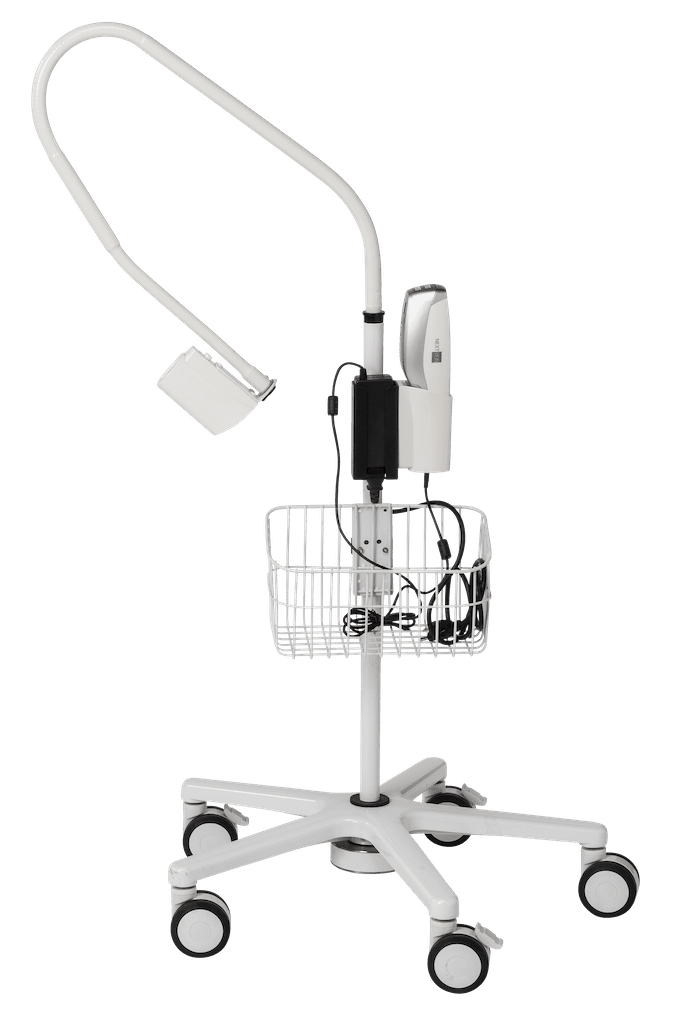
Handheld and hands-free options. Some procedures need both clinician’s hands free. A device that converts quickly to a hands-free configuration on a stand handles those cases. If your use case includes any procedure requiring two hands, evaluate the stand or hands-free option as carefully as you evaluate the device itself.
Battery life and charging. Manufacturers usually publish continuous-use battery numbers, which is rarely how devices actually get used. Real use involves frequent on-off cycles and standby periods. Ask about standby time, charging time, and whether USB-C or another up-to-date standard is supported.
Cleanability and durability. Vein finders get cleaned constantly. Ask which disinfectants the device tolerates, Devices without moving components inherently have higher levels of durability. You should ask your manufacturer how long a repair will take and whether they provide immediate replacement units. A device that fails after a year and leaves you without a replacement for too long during a repair cycle is expensive at any price.
A few things that get marketed heavily but matter less in practice: specific wavelength numbers (the clinical differences across the common ranges are small), patented technology claims (this variable is not a driver of patient safety or satisfaction), and peak depth detection specifications (real-world depth varies enormously with patient factors). These aren’t irrelevant, but they shouldn’t dominate your evaluation.
Look beyond purchase price to total cost of ownership
The headline price of a device is one component of what it costs your facility. The full picture usually surfaces only when you look at three to five years of ownership. The complete cost picture includes:
The purchase price itself. Straightforward, but make sure you’re comparing equivalent configurations. A “base” price without the stand isn’t comparable to a “complete” price that includes one.
Warranty coverage. How long is the standard warranty, what does it actually cover, and what’s excluded? A 1-year warranty followed by paid extensions is meaningfully different from 3-year coverage included in the base price.
Battery replacement. Rechargeable battery capacity degrades at some point. Some manufacturers include battery coverage in service plans; some charge separately. Battery replacement on a 3-year-old device can run several hundred dollars per unit.
Service and repair costs. Where the device gets serviced, how long that takes, and what it costs when out of warranty. US-based service typically has faster turnaround than international.
Loaner availability. When a device is out for service, do you lose use of it entirely, or does the manufacturer provide a loaner?
Accessories and consumables. The NextVein stand is protected through our Total Protection Plan, which bundles forward-swap replacement, battery coverage, and US-based service into a single offering. Other manufacturers structure their service differently. Compare the complete picture, not just the upfront price.
When you build the comparison, do it over a realistic timeframe (typically three to five years) and include everything you’d actually pay during that period. The device with the lowest sticker price isn’t always the lowest total cost.
Evaluate the vendor, not just the device

Once you’ve narrowed to two or three candidate devices, evaluate the manufacturer behind each one. A great device with poor service infrastructure becomes a problem the moment something goes wrong.
Questions worth asking each vendor:
- Will you provide an in-facility evaluation device before purchase? Any manufacturer worth considering should say yes. NextVein offers a no-cost in-facility evaluation system so you can use the device on real patients before committing. If a vendor won’t provide an evaluation, that itself is information.
- Can you provide references at facilities similar to ours? Ask for specific contacts at facilities matching your setting and size. Talk to actual clinicians at those facilities, not just sales contacts.
- What are the warranty terms in writing? Verbal commitments don’t survive personnel changes. Get the warranty terms, service commitments, and response time expectations documented.
- Where is service performed and how fast? International service depots add weeks to turnaround. US-based service infrastructure with clear response commitments matters when a device fails during patient care.
- Are you on our GPO contract? If your facility purchases through a group purchasing organization, GPO availability affects both pricing and procurement workflow.
- What does training and onboarding look like? Especially for larger deployments, vendor support during rollout matters. Ask about training materials, online training, and ongoing support.
The vendor’s answers to these questions tell you what life will be like as a customer. Clear, specific answers indicate a vendor that has done this before and built the infrastructure to support customers well. Vague answers are a warning.
Watch for red flags during evaluation
A few signals worth paying attention to during your vendor conversations:
A manufacturer that won’t provide clinical evidence or cites only their own internal studies. Real efficacy data exists for vein visualization technology. Any serious vendor should be able to point to peer-reviewed work.
Warranty terms that aren’t clearly documented in writing. If the warranty is verbal or vague, you don’t have one.
Pressure to purchase without an evaluation period. For a multi-year procurement decision, vendors should welcome an evaluation. Pressure to skip it suggests the vendor knows the device won’t perform as advertised in your environment.
Vague answers about service infrastructure. “We’ll take care of it” isn’t a service plan. You want to know where service is performed, how long it takes, and what it costs.
Marketing that focuses entirely on technology differentiation rather than clinical outcomes. Patented technology claims are useful only if they translate to better outcomes. Vendors who can’t connect their technology to clinical results are usually overselling the technology.
None of these is automatically disqualifying. Two or three together should make you cautious.
Run a structured evaluation before purchasing
Once you’ve identified two or three candidate devices, evaluate them in your actual environment. Marketing claims and spec sheets only tell you so much. The reliable way to evaluate a vein finder is to use it on real patients in real clinical conditions.
A structured evaluation includes:
- Multiple clinicians using each device. Different hand sizes, different experience levels, different shifts. Get feedback from the people who will actually use the device daily.
- Real patient diversity. Use the candidate devices on the patient population you actually see, including the difficult cases where vein visualization most matters.
- A consistent comparison framework. Same evaluation criteria across all candidates so you can compare results meaningfully. Document what you find as you go.
- Enough time to assess durability. A week isn’t long enough to evaluate how the device holds up in real conditions. Two to four weeks gives a more honest read.
- References from similar facilities. Talk to clinicians who’ve used each device for at least a year, not just the vendor’s curated success stories.
The evaluation phase often surfaces details that don’t appear in any marketing material: how the device feels after a long shift, how staff actually use it versus how they’re trained to use it, how it integrates with existing workflow, what breaks.
Build the procurement case

For institutional purchases, your final task is often building the case for approval. The work you’ve done through this evaluation gives you what you need: clear use case definition, feature comparison grounded in clinical reality, total cost of ownership and return on investment analyses, vendor evaluation, and evidence from a structured trial.
Document your decision rationale. Procurement teams and finance reviewers will ask. Having the answers ready, in writing, with specifics, makes approval easier and faster.
Final thought
The right vein finder for your facility is the one that integrates well with your clinical workflow, performs reliably on your patient population, and provides reasonable total cost of ownership across years of use. That device exists, but finding it requires doing the work of structured evaluation rather than relying on vendor marketing.
If you’d like to include NextVein in your evaluation, you can request a no-cost in-facility evaluation system or request a price quote or request assistance with an ROI analysis in hospital facilities for purchase consideration. Either way, we hope this guide makes your evaluation easier and more rigorous, regardless of which device you ultimately choose.