The Best Vein Finder for Nurses: What the Evidence and the Device Actually Show
IV starts are one of the most common procedures nurses perform, and they can be one of the most stressful when veins are difficult to locate. Missed sticks affect patient satisfaction, increase procedure time, and add to the burden on both the patient and the nurse. Choosing the best vein finder for nurses is a question about which device fits the way bedside care actually happens, is supported by clinical evidence and is built for the patient populations nurses see every day.
This guide covers what the clinical research shows about vein visualization in nursing practice, and how the NextVein V800NV is built for bedside use. Every claim links to its source.
Why Vein Visualization Has Become a Standard Tool for Nurses
The Infusion Nurses Society’s Recommendations for Improving Safety Practices With Short Peripheral Catheters explicitly recommends incorporating vein visualization technology “as a routine strategy for patients with difficult or poor venous access,” noting that visualization can improve success rates, decrease unsuccessful insertion attempts, and improve patient satisfaction (Vizcarra et al., Infusion Nurses Society, 2014).
The 2016 Infusion Therapy Standards of Practice (Gorski, Home Healthcare Now, 2017) reinforce this direction for home healthcare and self-infusion patients as well.
Nurses commonly encounter patients whose veins are difficult to locate by touch alone, including elderly patients, patients who are dehydrated, and patients with a history of frequent IV access. A fuller summary of the supporting research is available in NextVein’s clinical reference library.
What the Clinical Evidence Shows
Two studies stand out for nurses considering adoption.
Escalations to the IV team dropped 45% after near-infrared adoption. A study of the implementation of near-infrared vein visualization at a hospital reported a 45% reduction in escalations to the central IV team, an 81% improvement in nurses’ ability to cannulate, and a 93% success rate within one or two sticks (Delvo-Favre et al., Infusion Nurses Society 2014 Annual Meeting).
Pediatric DVA patients saw first-stick success rise from 14.3% to 85.7%. In a study of peripheral IV catheter placement in children aged 0 to 3, vein visualization improved first-stick success by 48% across the full population and by 83% specifically in patients with difficult venous access. Pain scores dropped 43%, the number of attempts fell, and total procedure duration was reduced by 81% (Demir & Inal, Pediatric Emergency Care, 2018).
Fewer Failed Attempts Mean Better Patient Outcomes
Research has shown that difficult peripheral intravenous catheter (PIVC) placement can delay diagnostic testing, CT imaging with contrast, medication administration, and other time-sensitive treatments. Multiple insertion attempts also increase patient anxiety, procedural pain, reduce patient satisfaction, and increase the risk of infection associated with repeated venipuncture.
When peripheral IV access cannot be established after several failed attempts, patients may require escalation to a vascular access team or placement of a peripherally inserted central catheter (PICC) or other central venous device. While these devices are essential when clinically indicated, reducing unnecessary escalation helps minimize procedural complexity and potential catheter-related complications.
These outcomes, particularly the reduction in escalations and the improvement in nurse-led first-stick success, are the metrics that most directly reflect day-to-day nursing practice.
What the NextVein V800NV Provides for Nurses
The features below are the ones NextVein highlights on its nurse-focused overview page and its handheld vein finder product page.
Real-time vein imaging projected on the skin
The V800NV uses near-infrared light to detect hemoglobin in the veins and projects a real-time map of the vein pattern directly onto the patient’s skin. Because near-infrared detection responds to hemoglobin rather than to visible surface contrast, the technology works across skin tones and types.
Lightweight handheld design
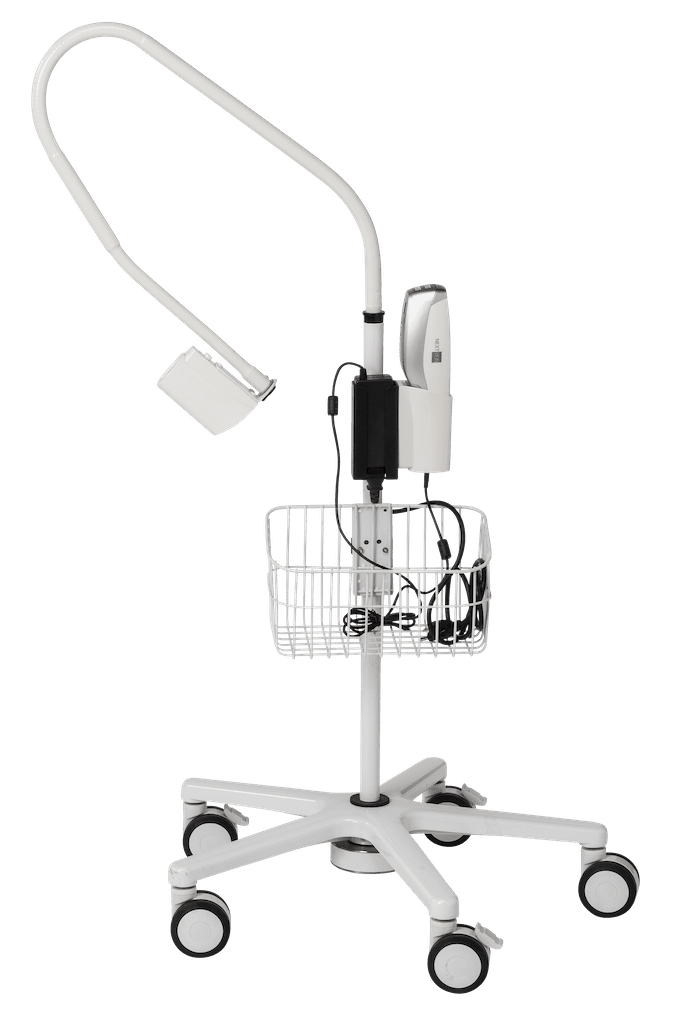
The device weighs 12 ounces and is designed for one-handed bedside assessment. Hands-free operation is available when used with its companion stand. It is non-contact, requires no gel, and is ready to use in seconds. It is held about 8 inches from the skin to project the vein pattern in focus.
Hands-free conversion for two-handed procedures
The V800NV converts from handheld assessment to a hands-free position using the S800NV long-reach wheeled stand. This keeps the vein map visible during the procedure itself, when both hands are needed for cannulation.
Two display modes
The V800NV offers two display modes: Mode A projects dark veins on a white background, and Mode B projects green veins on a dark background. NextVein offers these options for different clinical situations and patient skin tones.
USB-C rechargeable
The device is rechargeable via USB-C.
Total Protection Plan
Every system is backed by the NextVein Total Protection Plan, which includes a no-questions-asked warranty and an equipment forward-swap program that ships a replacement, even before NextVein receives the original, to keep your operation running.
More technical detail is available on the vein finder technology page.
Where Nurses Use the V800NV
The V800NV is in use across clinical settings where nurses most often encounter difficult venous access:
- Peripheral IV access, where NextVein’s IV access overview details how visualization supports the procedure.
- Long-term care facilities, where failed IV access can result in costly escalation to a hospital. More on this in NextVein’s long-term care overview.
- Blood draw and phlebotomy, covered on the phlebotomy overview page.
- Pediatric care, where the published evidence on DVA (Difficult Venous Access) improvement (Demir & Inal, cited above) is strongest.
How to Evaluate the V800NV for Your Facility
NextVein offers a no-cost evaluation program. Nurses and unit leaders can request a device for hands-on use with their own patient population before purchase. Start at the evaluation request page.
For purchase planning, the self-service price quote tool returns a quote by email. Purchase paths are listed on the United States buy page.
Summary
The clinical evidence supporting vein visualization for patients with difficult venous access is well established and recommended by the Infusion Nurses Society. The NextVein V800NV is a 12-ounce handheld near-infrared vein finder with hands-free conversion, two display modes, USB-C charging, and full-coverage service through the Total Protection Plan. The next step is to evaluate the device on your unit.
Request a no-cost evaluation unit or get a price quote to get started